
September 17, 2025
From Film to Digital, my Story.
Switching from film to digital photography was an extraordinary adventure. I would presume most photographers simply purchased new digital cameras, then sold their old film gear and moved on. As it turned out, my transitional process was far from what might be called normal.
I purchased my first 35 mm camera around 1979, and gradually, with more knowledge and experience, progressed in my critical selection of camera gear, thereby improving photo results. I began my photography business in 1981, and a short time later in ’85, turned full-time, opening a small studio in Anaheim Hills, California. Upon launching the new endeavor, one of the key investments included high-quality, medium-format film camera equipment; I chose a Mamiya RB-67 system. A darkroom for processing film and producing prints soon followed.

Above: Mamiya RB67 Pro S
Everything changed in 1997, when I founded a small, book publishing company, R.A. Cline Publishing. To my amazement, the new profession exploded with activity as it rapidly surpassed photography. Subsequently, I departed boat racing mid-1997, and stopped promoting the studio. Despite the publishing firm consuming the majority of my time, I still had the occasional commercial photography project, exclusively utilizing the RB-67’s. With the dawn of the digital-era, a few clients were beginning to inquisitively ask; “Are you switching to digital?” At the time, I was too busy in publishing to be concerned with the unknown world of digital, therefore I made no changes. As time marched on, the entire photography industry was rapidly falling into a full-blown crisis, the film and processing trade were dying, as digital was taking over the market. Clearly the end of main-stream film usage was in sight.
I was fully immersed in the publishing business when around 2002, an old photography friend phoned. He was quick to ask; “Do you still have film cameras?” When I responded “yes”, he excitedly said, “Sell that stuff immediately… while you still can.” It was true; I still owned several 35 mm cameras, and plenty of Mamiya RB-67 gear. Unbeknownst to me, their value was rapidly plummeting. I wisely took my friends advice, and directly began liquidating my film cameras.
About a year later, with all my film gear disposed of, I decided it was time to investigate this new digital craze I knew very little about. I first purchased a couple of inexpensive Kodak, point and shoot cameras, known today as a ‘digicams.’ They were small, and simple, but honestly I was not impressed, nor satisfied with the results. Suffering from small, sub-par sized sensors, poor optics, and with a low number of megapixels, they produced inferior image quality. Digicams also lacked any of the custom control functions I had grown accustom too. Consequently I began searching for something more substantial.

Above: One of my first digicams, a Kodak DX-3500
A life-time Canon user, I first considered their 1D, an impressive camera, packed with outstanding features. Introduced in December 2001, it was Canon’s first professional digital SLR. The 1D included a high-speed motor-drive, and larger sized 4.1 megapixel sensor. At a later date, I actually circled-back to purchase a 1D. Today I still own, and frequently use this fantastic camera. Then I discovered the newer Canon D60. Launched in 2002, it was slightly newer, and I believed included more advanced technology. Canon appropriately labeled their D60 a ‘prosumer’ (professional-consumer) camera. It had a mediocre motor-drive speed, not a factor in the majority of photo projects. More importantly at the time, it was equipped with a 6.3 megapixel sensor. Designed to look and feel like a traditional 35 mm, the D60 had a completely metal chassis, with a durable plastic outer skin. I was impressed, therefore in 2004, I made the purchase, and the D60 became my first ‘real’ digital camera. I was finally planted in the realm of digital photography, and the new learning process was underway.

Above: Canon D60 camera with optional battery grip attached.

Above: Early commercial photography job captured with the D60.
The following year, I resumed working professional photography jobs for paying clients, using the D60. I was admittedly trailing the latest and greatest in digital technology of the day (around 8 megapixels), however image resolution was very nice, and my results met happy clientele. After a nine-year absence, I re-visited drag boat racing in November of 2006, carrying the trusty D60. The camera easily endured the rapid pace of the IHBA World Finals, and performed flawlessly. I continued operating with the D60 for a few more years, before shifting exclusively to higher-quality, professional-grade cameras. While my knowledge of digital has since grown exponentially, I look back in amazement at the images captured with the D60. These older groundbreaking cameras proved to be an excellent starting point for learning, and using digital. I will not be reverting back to film; I am completely satisfied with digital, as it continues to produce outstanding results for my needs.
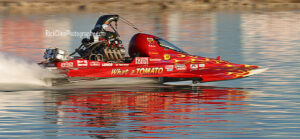
Above: “What a Tomato” top alcohol hydro, captured at the 2006 IHBA World Finals with my 6-megapixel Canon D60 camera.
Your comments on my Instagram page are welcomed.
Rick Cline

August 13, 2025
Lost Warbirds.
All photos by Rick Cline
During my career, I have photographed countless warbirds, and even once took a flight in a world war II B-25J Mitchell bomber. A handful of these vintage planes have since been lost in tragic accidents. In this memorable blog, I am respectfully highlighting these ill-fated aircraft, and the lost pilots. Photographed during their glory days, including how, and when they met their unfortunate demise. I did not witness nor photograph any of these plane crashes.
B-17G – “Nine-O-Nine”

he Boeing B-17G Flying Fortress 44-83575 was built by the Douglas Aircraft Company and was accepted by the military in April 1945. Arriving too late for use in World War II combat, the bomber instead was used for several military assignments until it was sold for scrap. Eventually, the four-engine plane was acquired in 1986, by the Collings Foundation, in Stow, Massachusetts.
Meanwhile, the original B-17G “Nine-O-Nine” was manufactured in 1943, by Boeing Aircraft, and nicknamed after the last three digits of its serial number: 42-31909. “Nine-O-Nine” completed an impressive 140 combat missions during World War II, without the loss of crew that few in the bomber. At the end of the European war, the plane was sent home in June of 1945, and subsequently scrapped in December that year.
The Collings Foundation decided to restore their newly acquired B-17G (44-83575) as a “tribute ship” to honor the original “Nine-O-Nine.” The warbird was painted as “Nine-O-Nine” including the “231909” numbers on the tail. The B-17 was afterwards flown and displayed at air show’s, where I first crossed paths with this legendary aircraft in 1992.

On the morning of October 2, 2019, “Nine-O-Nine” was engaged in a “living history” flight at Bradley International Airport in Windsor Locks, Connecticut. The flight had been delayed 40 minutes because of difficulty starting one of the engines. There were three crew, and ten passengers on board. Once in flight, the B-17 pilot radioed there was a problem with the Number 4 engine. With one propeller feathered, the bomber made a low approach in an attempt to land. Touching down about 1,000 feet short of the runway, the aircraft struck multiple landing lights, veered to the right off the runway, then crashed and burst into flames. Seven occupants died, including the pilot, Captain Ernest ‘Mac’ McCauley, and co-pilot Michael Foster, the remaining six were severely injured.
Northrop N-9M – Flying Wing

Above: At the Planes of Fame Museum, testing the new Franklin engines installed on the Flying Wing
The Northrop N-9M was first flown in 1942, the third all-wing aircraft’s designed by Jack Northrop. The twin-engine N-9M was constructed primarily of wood, around a metal tube section. A one-third scale plane, designated as a training platform to familiarize pilots prior to the production of the massive XB-35 Flying Wing bomber. Only four Northrop N-9M’s were ever produced, the first was lost in a flight test. After Northrop’s XB-35 program was canceled in 1949, two of the remaining three N-9M flight test aircraft, except for the final N-9MB, were scrapped.
The Planes of Fame Museum, in Chino, California, acquired the sole surviving N-9MB and kept the aircraft in storage until 1982, when an extensive restoration project finally began. For a few years, I occasionally stopped by, and sometimes photographed the plane during its latter refurbishment process. While rebuilding, the museum opted to upgrade the engines from the original 260 hp Menasco’s to more powerful 300 hp Franklin’s.
In November 1994, after 12 years of exhaustive work, the N-9MB was finally rolled-out and ready for preliminary test flights. Once all testing was deemed satisfactory, the historic plane was proudly flown at Southern California, air shows, where I again photographed the aircraft in flight.

On April 22, 2019, the N-9MB took off from the Chino, California Airport with 51-year-old David Vopat in the cockpit. Shortly after take-off, Vopat reportedly lost control of the aircraft, and crashed on the grounds of the California Rehabilitation Center, a state prison in nearby Norco. The plane was destroyed, and David Vopat died.
F-86 Sabre – “Sabre Dance”

Saturday, May 1st, 1993, Santa Ana, California. I was photographing the El Toro, Marine Corps Air Station, Air Show that day. At the time, the annual event was one of the largest spectator showings in the United States, known for attracting over 1-million fans during its 3-day performance.
Part of that show included a Soviet built Mig-15 jet fighter, flown by T.J. Brown, performing a mock dog-fighting routine alongside an American F-86 fighter named “Sabre Dance,” piloted by James A. Gregory. Gregory, a 40 year old stunt pilot and former Navy flyer was from Amelia Island, Florida. The following day, Gregory was again set to perform the same two-plane routine with his F-86 and the Mig-15. When Brown became ill Sunday morning, his Mig-15 was regrettably withdrawn from the exhibition. As a result, Gregory decided the show must go on, and opted to conduct a solo aerobatic program, an act not yet practiced for the show. Following take-off that afternoon, he began a loop with an aileron roll maneuver. During his rapid descent from the top of the loop, the F-86 developed a much higher rate of dive, and violently struck the runway in a pancake fashion, skidding for some 5,000 feet in a massive fireball. Tragically, James Gregory did not survive the crash.
Heinkel He 111 – bomber

The Heinkel He 111 is a German twin-engine medium bomber, perhaps the most widely known German bomber of World War II. Between 1939 and 1944, the German’s produced 6,508 He 111’s. Following the war, construction of the Heinkel resumed as the Spanish-built CASA 2.111. The Spanish produced 240 planes; their biggest design alteration was found in the power-plant used, being equipped with two, Rolls-Royce Merlin engines.
In 1977, the Confederate Air Force* of Dallas, Texas, purchased a post-World War II Spanish-built CASA 2.111 aircraft, and restored it, painted as a German Luftwaffe Heinkel He.111. Presented as the World’s last flyable He.111, the rare twin-engine warbird became very popular at air shows, where in 1995, I first saw and photographed this impressive plane.

On the morning of July 10th, 2003, the Heinkel He 111 departed Midland, Texas, en route to Missoula, Montana, for another air show appearance. Three hours later, the warbird was preparing for a routine refueling stop at Cheyenne Municipal Airport, Cheyenne, Wyoming. The tower controller cleared the pilot to land, and the airplane was observed on a 3-mile straight-in final approach when it began a sudden left turn. The pilot reported, “We just lost our left engine.” The pilot then announced he wasn’t going to make it to the airport. The bomber was 2-miles southeast of the airfield when it struck the ground, left wing first. Then slid through a chain link fence, hit a parked automobile, finally skidding into the Laramie County Independent School District school bus wash facility. The subsequent fire destroyed the plane, parked car, and the wash barn; pilot Neil R. Stamp, and co-pilot Charles S. Bates both perished in the crash.
*Note: In 2001, the Confederate Air Force was renamed the “Commemorative Air Force.”
Your comments on my Instagram page are welcomed.
Rick Cline
July 14, 2025
Flying Above the Pacific.
All photos by Rick Cline
One day at my Southern California studio, I received a phone call from a new client. He needed me to photograph his parasail business, located on Catalina Island. A few days later I boarded a small helicopter in Long Beach, and took a 29 mile flight to Avalon Harbor. Once I landed, I was met by the business owner, and we took a short ride to join his two boats waiting at the dock. The boats appeared identical, two nicely outfitted 28-foot cruisers, each equipped with a parasail unit. The business owner boarded boat one, while I stepped into boat two. We soon headed east, out to sea where they promptly raised someone into the air in a parasail behind boat one. The large parasail was attached with a winch device, allowing the operator in the boat to gradually release line and control the altitude. The weather was beautiful, a light breeze, clear blue sky and everything was going well.

A while later, the radio in my boat came to life with a message; “Put the photographer up in the parasail.” I was pretty sure I understood what was said, however just to be clear, I asked the boat operator, “What did he say?” The driver responded, “He wants to put you in the parasail, so you can get photos from the air.” A bit stunned by the request, I wondered in my mind, is he serious? I didn’t recall any prior discussions about me going airborne. Truthfully I wasn’t fearful of the water, I knew how to swim, my biggest concern was possibly dropping one or two cameras into the ocean. They would be gone forever! My mind quickly switched back to the moment at hand. Lens wise, I briefly pondered, was I prepared for this sudden change in the agenda? There was nothing I could do; I had no choice but to make do with what I had in my camera bag, that’s what a professional does. With no verbal objections, I just smiled and prepared myself for an adventure I would not likely forget!

Above: Boat one, lower left, with a parasail in flight.
I said nothing while I hurriedly double-checked my cameras, lenses and gear, then carefully placed two cameras around my neck as I readied for flight. Stepping onto the launching area at the rear of the moving boat, I realized this was going to be my first flight in a parasail. I was methodically strapped into the apparatus, and promptly felt myself carried away over the vast blue ocean. The parasail operator was good; he knew what he was doing. I was slowly gaining altitude, drifting higher and higher above the Pacific. In a matter of a few minutes my increasing elevation made communication impossible. I could faintly hear the sound of the boats running far below, but mostly just the wind blowing around. Gradually everyone in the two boats became so small they were not recognizable. Although a monumental challenge to photograph moving boats and even another parasail from a high-flying parachute with no solid support beneath me, I was successfully able to capture some uniquely magnificent images.


Above: My vantage point above the parasail behind boat one.
Eventually my speeding tow boat driver skillfully maneuvered toward boat number one; where I found myself flying high above and behind both boats, even exceeding the heights of the parasail trailing boat one. I was clearly not in control of where and how high I would soar, so I just kept snapping photos. I must have spent more time photographing from the parasail than any other position of the day. Ultimately my parasail operator began to reel me back to a somewhat solid footing, aboard the whizzing 28-footer. Still a few miles out to sea, yet within site of Catalina, the two boats turned west and sped in the direction of Avalon Harbor. My day-long photography project was completed, I returned to the helicopter pad where I loaded my gear for a short flight to the mainland. The client was very happy with the results, and it was a photography project I would remember for a lifetime.
Your comments on my Instagram page are welcomed.
Rick Cline
June 11, 2025
My first Drag Boat race.
In early 1981, I decided to attend my first drag boat race, a long-time fan, this was a sport I was very interested in photographing. Living in Bakersfield, California, not far from Lake Ming, I was about to open a door that would forever change my life.
Auto focus, digital cameras, and the internet were not yet invented; in photography, manual focus, 35 mm was the name of the game. I owned a good 35 mm camera, not a professional model; it was a Canon AT-1. This camera was equipped with a match-needle metering system requiring the photographer to manually set both the shutter-speed and aperture to obtain the correct film exposure. It lacked a film winder or motor drive; you manually advanced the film after each shot. However an optional power film winder was available from Canon.
Weeks prior to this NDBA race, I took my camera to the lake, stood where I thought the finish line would be, and peered through my biggest lens, a somewhat common 200 mm. It was immediately obvious this lens was severely inadequate. With no prior experience or knowledge, I opted to purchase a 400 mm lens, thinking this would allow me to reach the action, in truth I didn’t know, I had never owned or used a lens of that size. Next I invested in a power winder, another camera device I was unfamiliar with. The winder would shoot just 2-frames per second; much slower than the Canon pro cameras at that time, running at 3.5 frames per second.
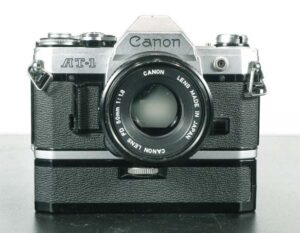
Above: Canon AT-1 35 mm camera with a power winder attached.
When qualifying began Saturday morning, I was at the waters edge holding my camera loaded with color slide film. In 1981 most photographers were using either black and white, or color negative film. I already knew, no one in Bakersfield could process slide film, it had to be shipped out of town for developing. Prior experience taught me, dropping off for processing Monday, at best wouldn’t bring results until Wednesday afternoon.
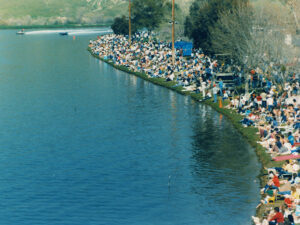
Above: NDBA Lake Ming.
Late Saturday afternoon, Ed Murphy crashed his modified jet. Crossing the finish line at 97 miles per hour, the boat flew over backwards in a violent accident. When the boat first lifted off the surface of the lake, I instinctively depressed the shutter button and held it down for 3 or 4 seconds. With my eye glued to viewfinder, the camera was firing as fast as possible, and I couldn’t believe what I was seeing. A few seconds later, it was over.
When the race ended Sunday evening, I could not wait to see my photography results. Meanwhile I was sure the local newspaper had captured the crash, and would publish their series of photos, but to my surprise, nothing. Instead they ran a story about the incident, telling of the drivers’ injuries, and how he miraculously survived.
Wednesday afternoon, all my developed film arrived and I quickly started searching for the important images, stopping when I saw my colorful results. I believed they were spectacular, I knew what I had to do next, and time was running out. I was a rookie, unknown, inexperienced photographer, with the greatest photos I had ever captured, so I rushed to the local newspaper. I was overjoyed, the sports editor was equally impressed by my images, and wanted to use them for their Friday morning edition. Three photographs were spread over the front page of sports, I was very proud of my work; achieving results beyond expectations, and the newspaper paid me for publishing the photographs.
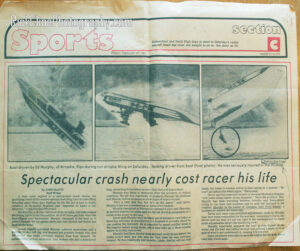
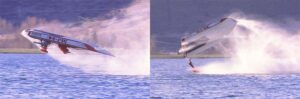
A few years later I learned a surprising back story to this 1981 success. A newspaper photographer was indeed at the race that day. He loaded the pro Nikon camera with black and white film, and supposedly shot the crash. Upon unloading the camera for processing that evening, the developed film turned up blank, an entire roll of Kodak film; nothing! While loading his camera that day, the photographer made a critical mistake, failing to properly feed the film into the take-up spool on the other side of the camera. As a result, the camera fired, and appeared operationally normal, but inside the device, his film never advanced, and thus never exposed. I was the only photographer who captured the crash.
Your comments on my Instagram page are welcomed.
Rick Cline